Situation
One of my responsibilities within Bosch included enabling Bosch North America to become aware of, understand, and leverage Design Thinking in their work.
At our 2016 Regional Executive Meeting (REM — top 150+ executives within Bosch North America), I introduced the concept of the “Customer Journey.” Coincidentally a few weeks after my presentation, the Harvard Business Review published an article entitled “What You Can and Should Be Doing with Your Customer Journeys.”
The confluence of events, mixed with the urgency caused by Dieselgate, created an appetite within Bosch to find silver bullets, even if it meant listening to a Designer.
Despite the enthusiasm, we ran into a problem very quickly. The entire company had glommed to the term “Customer Journey” without understanding the concept.
Many in the organization proclaimed an intimate understanding of a customer’s journey because they knew their customers well. As one of our EVPs told me, “I’ve been in this business for more than 30 years. I know the customers better than they know themselves.”
To compound matters, many of our design and marketing teams had begun creating Journey Maps filled in from a Bosch perspective.
As we approached the 2017 Regional Executive Meeting, I knew we had to educate the leadership in a way that would resonate.
Task
The Regional Executive Meetings were, without fail grueling. Three full days of updates, plans, and initiatives for a group as different as Dremels and Air Bag sensors. By 4 pm on the third day, people were desperate to get to an airport.
Through conversations like the one I mentioned above, I understood that perspective was the heart of the matter.
How do you get insiders to think and feel like outsiders?
Knowing the audience could only engage with problems differently if they experienced something that made them think differently, I decided to give an interactive presentation disguised as an activity break.
Action
I went on stage at 4 o’clock and got massive applause when I said I wasn’t there to lecture them on Design Thinking. I said, “We’re going to switch it up a bit today, and we are going to go racing for charity.”
- After a partial overview, we divided the group into teams, and we assigned each team a facilitator.
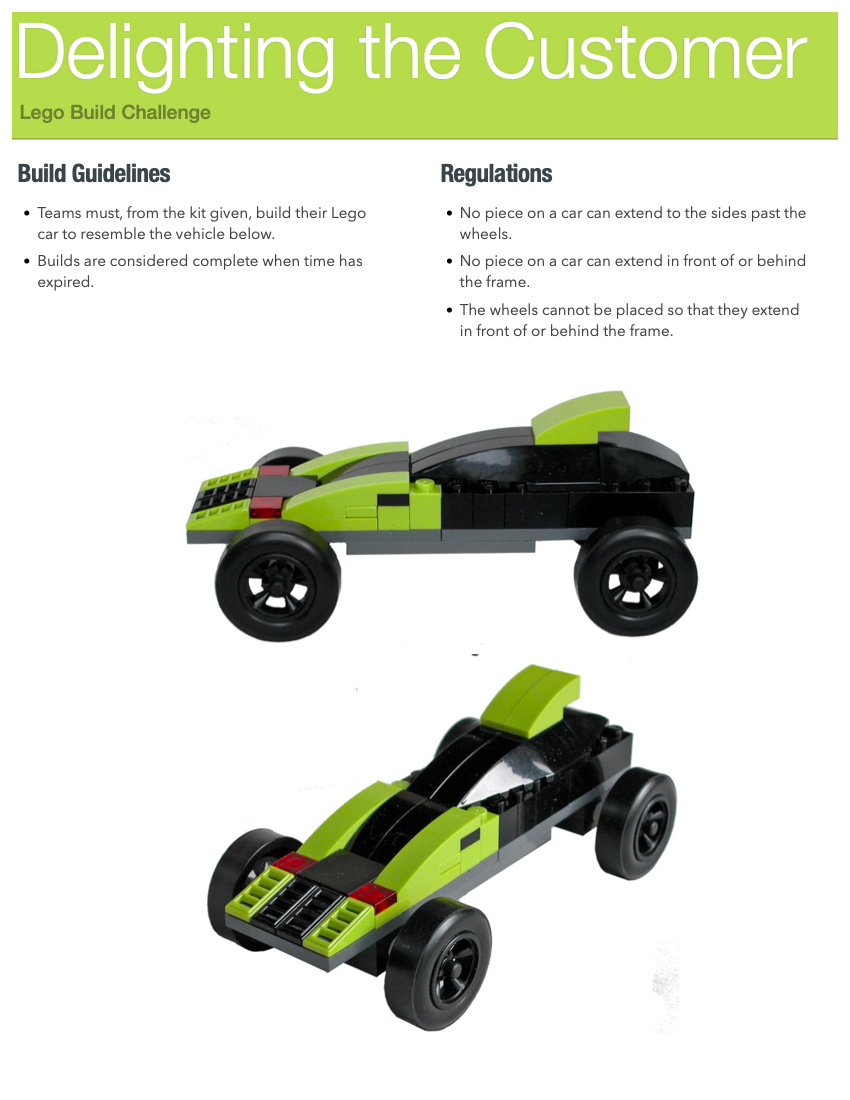
- They would have 15 minutes to take a bag of Legos and make a race car. The car had to match the design shown, and we gave them directions to follow.
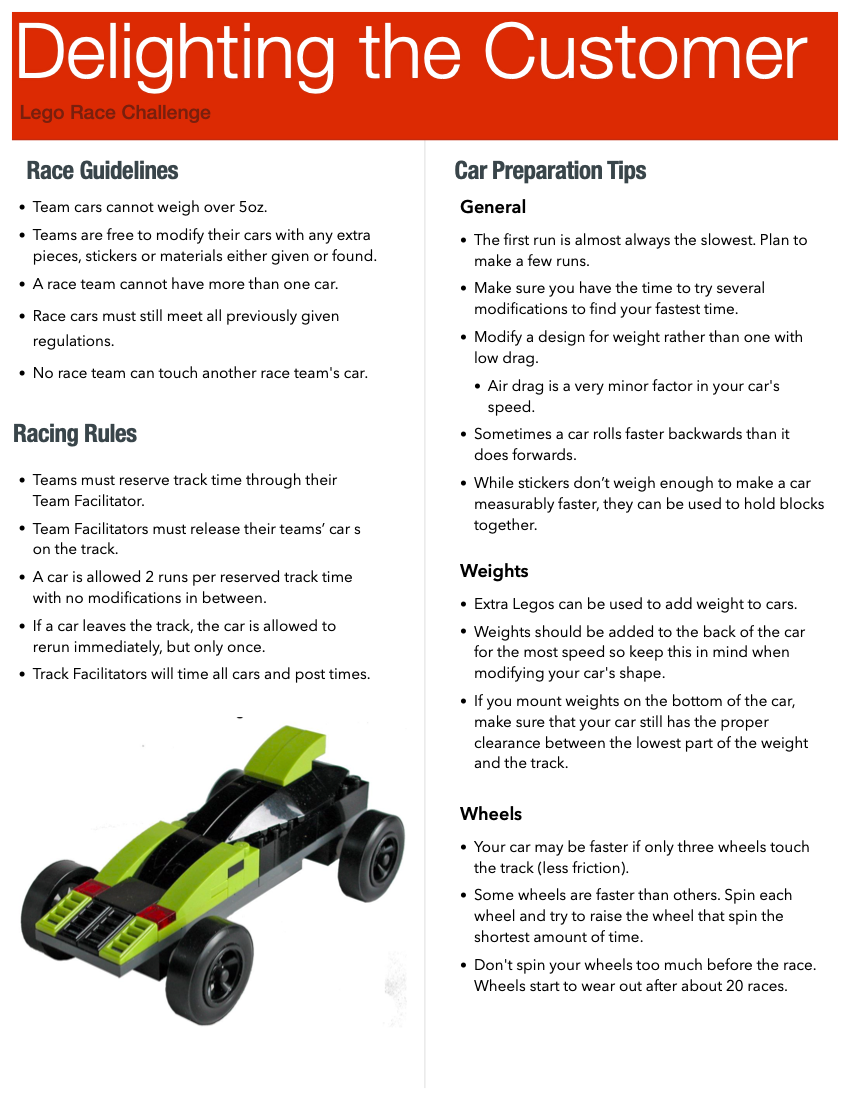
- After 15 minutes, their facilitators would add them to a list of teams at one of the three race tracks we had set up. Their car would be allowed two runs. The track facilitator would record times for all the teams.
- After the first track session, they had another 15 minutes to modify their cars. At the end of 15 minutes, their facilitator would add them to another list, and they would have a final two runs at the track.
- After the teams finished their second track session, we would announce the fastest team, hand out the trophies, and donate $5,000 to the charity of their choice.
Unbeknownst to the leaders, we divided our teams into Happy Teams and Sad Teams.
Happy Teams would have the experience every corporate leader at a corporate event would expect.
- Their parts bags were checked twice to ensure they had every part.
- Their instructions were clear and succinct.
- Their facilitators were engaged, eager, knowledgeable, and thoughtful.
Sad Teams would have a different experience because we created a few challenges for them.
- Their parts bags were initially missing trivial things, like wheels.
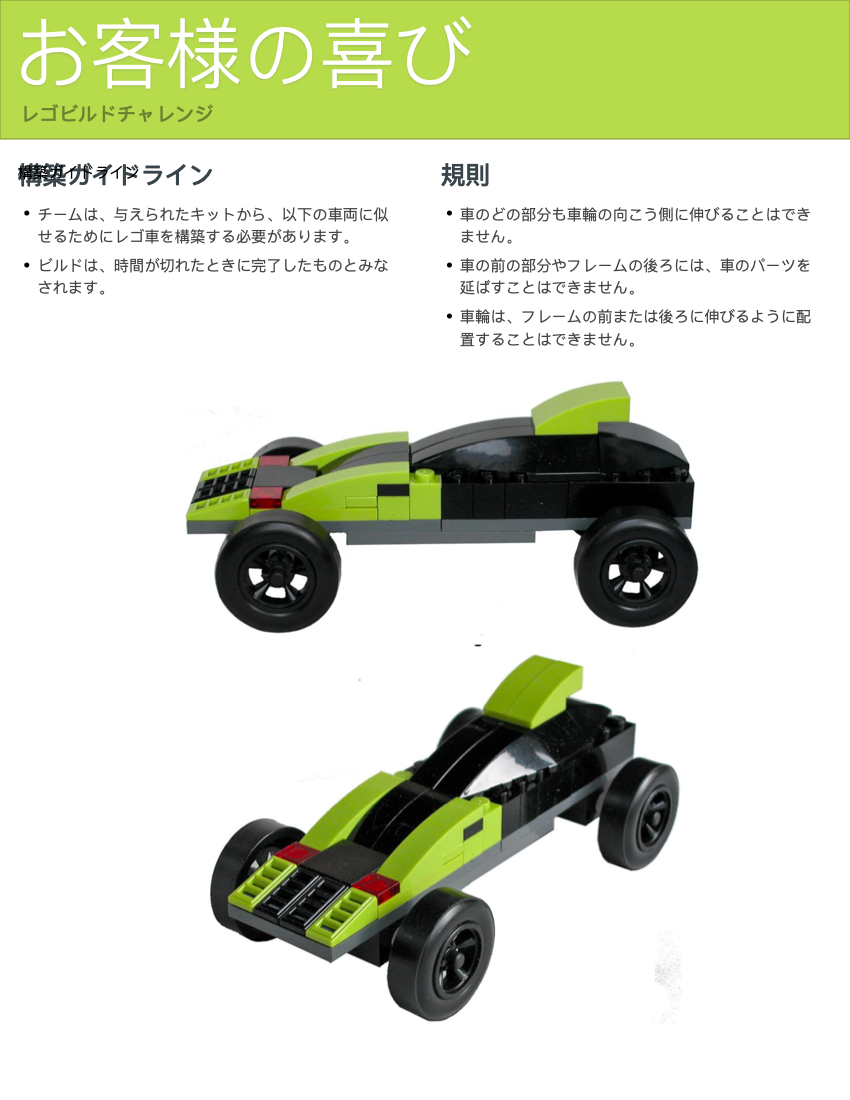
- Their instructions were in Japanese (I made sure none of the executives spoke Japanese 🙂)
- Their facilitators were unaware of things like where the parts bags were, where the tracks were.
- In some cases, the facilitators would go missing for extended periods.
After all the teams completed their second runs and returned to their seats, I came back on stage to walk the group through what had happened.
We talked about how Bosch was responsible for a component that fits into a larger journey. We were the team that made the Legos.
We focused in on how little we could understand customers’ journeys from our internal vantage points. We had no better chance of understanding a customer’s journey than LEGO did of understanding the journey of our activity. Still, those details impact our revenue and satisfaction with our products and services.
Results
While the session was hit from an entertainment perspective, I measured the impact with two results:
- Awareness — How many leaders brought us into their teams to share the same message?
- Project Revenue — How many teams contracted with us to undertake journey mapping projects that would allow them to find areas of opportunity?
Within one week, we had booked travel to seven Bosch offices across North America to take the Lego show on the road. Within four weeks, we had to bring in external agencies to help address capacity.
Our revenue target for 2017 was $900k, and we closed the year at just over $1,200,000.
Most importantly our work led to product development efforts such as Robinair’s Connected R-1234YF ACS Machine with industry firsts such as digital displays and over-the-air updates.